Sounds of Fes

The Place As-Safarine, in Fes.

I haven’t posted much about my trip to Morocco in April and part of the reason is a fear of trying to sound authoritative about a culture and history that I am not really a part of and that I am only just beginning to learn about. It’s not that the trip wasn’t striking, inspiring, and fulfilling–it certainly was. I just don’t want to sound like a neo-colonial travel blogger expounding on what a great time I had discovering all the great Moroccan wonders, when really it was a trip that followed a pretty typical touristic trajectory.

I did want to share one of my favorite moments, though. On our first day in the country, my friend A. and I wandered the incredibly intricate and notoriously confusing Fes medina in an exhausted, sleep-deprived daze. Vendors called to us in French and English and ventured guesses as to where we might be from. We tried to give fellow pedestrians enough space to pass in the narrow paths but still got caught in more than one bottlenecked crowd. We dodged men pushing carts filled with various goods and yelling the typical “balak!” (“look out!”) and on numerous occasions, we narrowly escaped being trampled by small-but-feisty donkeys that seemed to appear from nowhere. A number of young children competed persistently to act as our guide and though we were acutely aware of the poverty around us, we also remarked how much better these kids’ English was in comparison with our students back in France. (In passing a famous medersa/mosque, one boy stated in a matter-of-fact way: “Would you like to go in there? Well you can’t. It’s only for Muslims.”)  Between whiffs of fresh-baked pastries and other food items at every corner came the all-encompassing leathery smell wafting from the tanneries.

Finally we came across the Place As-Safarine, or Square of the brassmakers, which we had read about. At first the noise was near deafening, as men crafting brass products by hand pounded at misshapen metal. It was a moment that we came to find increasingly common in Morocco, as we wondered how much of this display of a thousand-year-old tradition was still legitimately producing brass products and how much was just that–a display. But it was too loud to think much about how globalized capitalism has affected local craftwork anyway. We found a rooftop cafe on the square (another common and wonderful feature of Moroccan cities, though it is sadly limited to the sector of society that can afford them), ordered mint tea, and listened to the sounds of the metalwork. We didn’t exchange words for a long time.
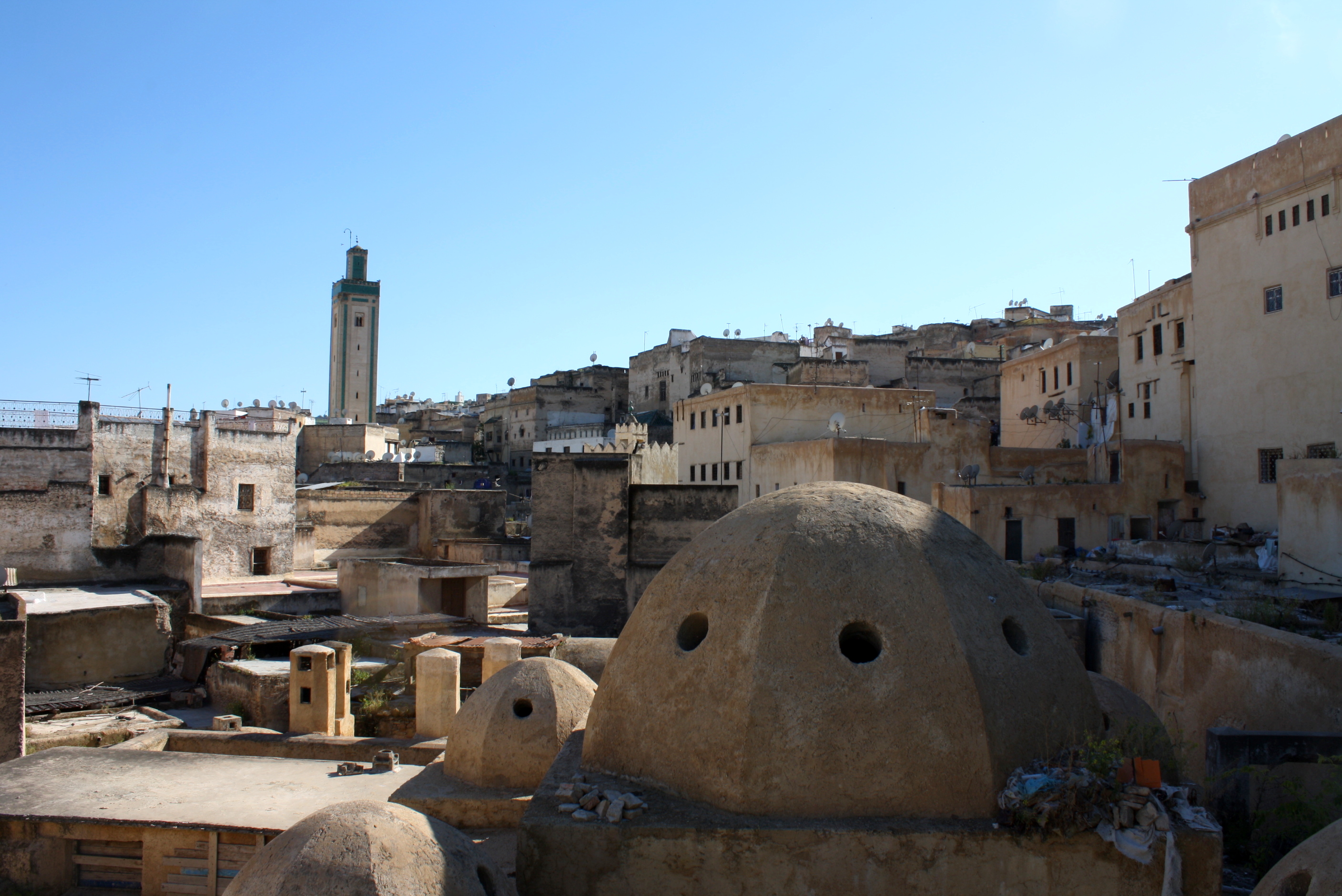
View from the roof.

You would think the sounds of pounding metal would be utterly distracting: sometimes melodic, other times completely out of sync. But it occurred to me recently how much that travel-induced exhausted daze can be just the right thing at times, for in that moment I was not grumpy or displeased but merely too tired to think much of anything, or do anything beyond just be. We had no inkling of what the rest of the trip might bring, nor any idea what it would be like to spend two weeks with only each other. But it’s always a good harbinger when you can comfortably sit in silence with someone. Or if not silence, mind-numbing (in a good way!) noise.

Small towns, slow food

Because I clearly needed a vacation from my already vacation-like life, I took a train to Italy last month to visit Maria, an old friend from Oakland and Berkeley who is currently studying gastronomy in Pollenzo (the birthplace of the “Slow Food” movement).

Maria and most of her other culinarily-inclined friends live in a nearby town called Bra. I’ve visited the large urban tourist destinations in the rest of Italy (e.g. Rome, Venice, Florence) but I was looking forward to spending time in a more anonymous small town. I was not disappointed—the uniqueness of its location (in the Northern Italian region of Piemonte) was evident from the start. I arrived at the surprisingly run-down station of Torino Porta Susa, which included hole-in-the-floor “restrooms,” and somehow figured out how to purchase a second train ticket to Bra from a machine that was yelling at me in heavily-accented English while a gypsy asked me for money. I didn’t know you had to punch your ticket before getting on the train (what is this, the 1950s??) and there was no sign telling me to do so, but luckily I was never asked for my ticket on this particular ride. The train itself was nice, but where was the detailed map indicating the route of the train and all the serviced stops? Clearly, I was not in Paris anymore. Luckily Bra was the terminus of the train, otherwise I would never have known where to get off—almost none of the deserted-looking stations we passed had any signs on them whatsoever. But after about 45 minutes of staring at the regal, awe-inspiring Alps in the distance with only a vague uneasiness as to where on Earth I was, I arrived at my destination. And it was well worth the effort. Bra is beautiful, quiet, charming…adorned with gorgeous buildings, cobblestone streets, and a few central stylish cafés.


Continue reading “Small towns, slow food”

Egypt: What’s different

The past couple weeks have been my first in Cairo since the January 25th revolution. As soon as I arrived I was eager to identify tangible changes in a city I used to know more than any other. (Of course, not all changes are tangible.) So what follows is a list, in no way intended to serve as substantial political analysis, of just that. It is a list based completely on my own observations and some anecdotal evidence, but if you know me then you know where I’m coming from, and this list might help you to understand Egypt how I see it, as well as Egypt as it is, a tiny bit better.

1. Election posters.

Because of Egypt’s high illiteracy rate, candidates are also represented on ballots with a symbol. As seen here one man’s is a ladder, and the other has the eye of Horus.

The very fist thing that was obviously different to me, that I noticed on my first walk outside my parents’ apartment in Zamalek, were these election posters pasted over walls everywhere. Since this is a country that had not had “real” elections in decades, posters like these are completely out of place to me. Before, if anyone’s face graced public spaces, it was Mubarak’s. Though when I visited exactly two years ago, we also spotted a couple posters of Gamal Mubarak, the President’s son, who was repeatedly described in the foreign press as being “groomed” to replace the sickly Hosni. I remember the ominous feeling that gave me, the prospect of this cruel dictatorship continuing as before with a newer, younger face, a prospect that pleased no Egyptian that I knew.

This time around, I’ve seen Mubarak’s face I believe a total of three times, and in no positive context–primarily in graffiti critical of his regime. Today, it is faces of anonymous Egyptian citizens-women included–that cover the walls of the city.

Continue reading “Egypt: What’s different”

La Défense

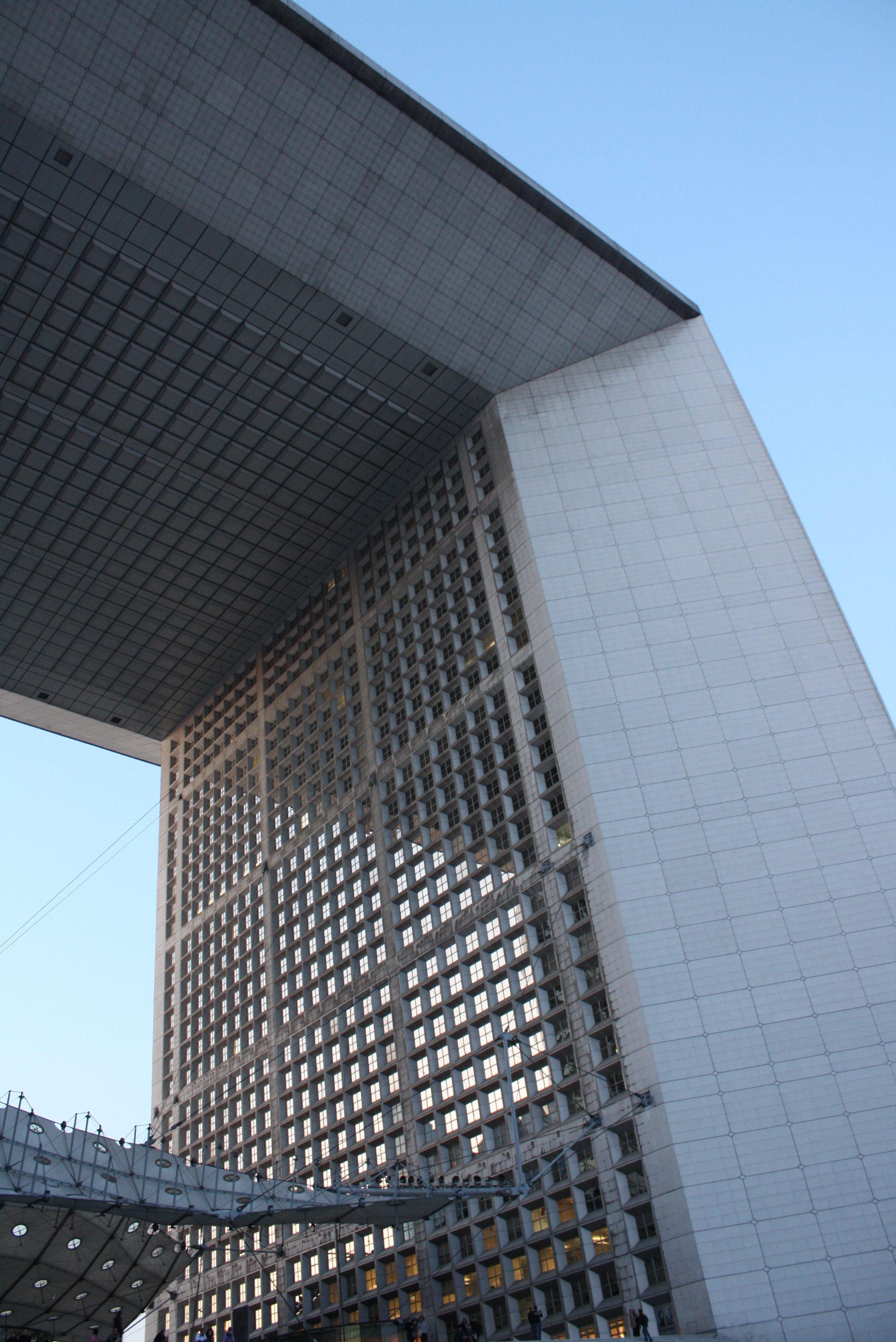
It’s not in the news, barely even in French news, but there is an Occupy encampment here in Paris. It’s just not at Hôtel de Ville. It’s at La Défense, Paris’ main financial district on the Western edge of the city that emerged in the 70s and 80s and is now the largest purpose-built business district in Europe. The district completes the Westernmost end of the Axe historique, which is a straight line leading from the Louvre through the Champs-Elysées, the Arc de Triomphe and ending at La Grande Arche, the iconic modern monument of La Défense. Originally, the axe historique allowed the King a grand vista from the Louvre (his palace) straight to the Western end of the city.

It was there that I went last weekend to attend the general assembly of Occupons La Défense. I had never been to La Défense before, always being vaguely curious about its famous architecture, so as I first stepped off the metro I was immediately struck by the enormity of La Grande Arche, and the glitz of the surrounding financial buildings. Considering Paris is one of the most well-preserved European cities, with countless buildings and cathedrals hundreds of years old and only one skyscraper, this modern outpost could be Paris’ polar opposite. According to Wikipedia, construction of La Grande Arche began in 1985 after Danish architect Johann Otto von Spreckelsen and Danish engineer Erik Reitzel won a design competition initiated by then-French president François Mitterand. Apparently, they intended the monument to serve as a 20th-century version of the Arc de Triomphe, honoring humanity and humanitarian ideals rather than military victories. Of course, the building was inaugurated with grand military parades at the bicentennial of the French Revolution. And looking at it today, the stark grey and silver angles of the structure remind me of anything but “humanitarian ideals.”

The Grande Arche would not fit in my viewfinder

Continue reading “La Défense”