[from November 2011]
Tag: paris
Notes from Meaux-town*
Every Monday and Tuesday I wake up around 6am, get ready and head to Gare de l’Est, from which I take a train to Meaux, a small town of around 50,000 people East and slightly North of Paris. This is where I spend two days teaching English to around 14 primary-school classes of children aged anywhere from 6 to 11. Notice I say “teach”—while I have no teaching credential and am supposed to be an “assistant” who merely helps the teachers with their English lessons, offers the correct pronunciation of words, maybe plans a few activities, the program and schools themselves are highly disorganized when it comes to English and so somehow I am essentially the English teacher.
Meaux is a town with a large immigrant population and an allegedly racist mayor. Besides a vaguely quaint town center with a cathedral and a somewhat substantial reputation for Brie and mustard, there’s not a whole lot to report on. When I arrive at the train station I hop on a bus and bypass the center anyway, heading instead for the neighboring industrial zone. This is where my schools are located, surrounded by housing projects. This doesn’t have the same connotation as “the projects” in the US do, but it does feel a million miles away from Paris. More than anything, it can feel dreary and rather deserted. The teachers, not knowing that I was placed in the town by the teaching assistant program, have asked me confusedly, “but why did you choose Meaux?” Riding the bus here I feel totally anonymous, and an English title on the book I’m reading will generally get me a few looks. It’s a complete contrast to cosmopolitan life-as-spectacle Paris, and that’s one reason I’m grateful for the experience.

Though Meaux doesn’t feel as “cosmopolitan” as Paris, ironically my schools represent a sort of mini-multicultural utopia that Paris could only dream of coming close to. The students have more diverse origins than anywhere I’ve ever seen: North and West Africa are probably the most commonly represented, but there’s also Yemen, the Congo, Pakistan, Bangladesh, Portugal, Poland, Greece, French territories (like Martinique, Réunion, and French Guyana), Romania, China…and that list probably doesn’t even cover it. One lesson the kids loved was learning how to pronounce these countries in English.
Continue reading “Notes from Meaux-town*”
C’est cela, oui
So these “Shit ________ say” videos are getting completely out of control, and for the most part are not funny at all, but I couldn’t help falling in love with this one when my roommate showed it to me. I have no idea if a French person (or really, Parisian) would agree, but most of the phrases an mannerisms in this video are pretty right-on from what I’ve observed and experienced. You can detect his (American or Canadian?) accent in moments, but he’s got the timing and intonation almost perfect. Since I too have a penchant for accents and slang and pretending-to-be-french, I’d really like to find this guy and be friends.
Dickensian Paris
The wine was red wine, and had stained the ground of the narrow street in the suburb of Saint Antoine, in Paris, where it was spilled. It had stained many hands, too, and many faces, and many naked feet, and many wooden shoes. The hands of the man who sawed the wood, left red marks on the billets; and the forehead of the woman who nursed her baby, was stained with the stain of the old rag she wound about her head again. Those who had been greedy with the staves of the cask, had acquired a tigerish smear about the mouth; and one tall joker so besmirched, his head more out of a long squalid bag of a nightcap than in it, scrawled upon a wall with his finger dipped in muddy wine lees—BLOOD.
-Charles Dickens, A Tale of Two Cities, 1859
It feels like people don’t read Dickens much anymore—at least I can’t remember anyone I know recently having read him. The last I remember was everyone having to read Great Expectations in high school and hating it (since I enrolled in my high school late I somehow avoided reading it). In the mood for some classic literature over the holidays, I decided to remedy this mysterious Dickens absence with A Tale of Two Cities, which I chose due to its relative brevity and its subject matter—London and Paris around the time of the French Revolution. I wasn’t disappointed: because the novel was written in installments for a newspaper, Dickens uses common literary devices such as plot twists and cliffhangers, and the characters are rich and complex despite the short amount of time taken to develop them (though the central young female character is an annoying idiot who faints due to overwhelming happiness/sadness depending on what is happening to the various men in her life. Naturally.) But the best part is how the cities themselves act as characters in the novel—Paris of course being the bloodthirsty unstable force that pulls the characters towards it and forces them to unleash their suppressed guilt/rage/heroism…and that threatens to behead you at any moment. Yeah, pretty awesome.
I adore how Paris is introduced in the novel, with a scene in which a cask of wine is accidentally spilled in the street, and every man, woman, and child in sight struggles to drink the wine directly from the ground lest it be wasted, cupping hands to bring up wine and mud from in between the cobblestones in a hungry frenzy that culminates in the wonderful foreshadowing passage above. Given the overwhelming decadence of today’s Paris, where the satisfaction of every sense is available on every corner, there is always a certain fascination that comes with reading about the periods in Parisian history when the city was under siege or on the verge of revolution, when people were driven to survive by eating rats, or something of that nature. This is more the sort of portrayal that Dickens offers, with everyone so impoverished (though some can still afford wine) and haunted by that other personified force, Hunger:
Continue reading “Dickensian Paris”

Sound of the police
I just discovered that you can watch the entirety of La Haine (1995) on You Tube (so no need to spend a fortune on the Criterion Collection edition). So even though I’ve seen it a number of times, I feel compelled to watch it again. It is one of my favorite films of all time and one that embodies so many topics that fascinate me, as it is ultimately a film about exclusion from mainstream society and how this is reinforced in structural ways such as urban planning and police brutality. And of course, there’s no shortage of vulgar French slang and “Verlan,” a style of speaking that more or less inverses words: “femme” becomes “meuf,” “bizarre” becomes “zarbi,” “arabe” becomes “beur.” Verlan is completely unique to the Parisian region and though it started among immigrants and other marginalized populations of the banlieues, it has spread throughout the city and elsewhere, much to the chagrin of the Académie Française’s arbiters of the French language.
I love this scene, which begins with shots of people hanging out in the housing projects’ playground. The DJ Cut Killer points his speakers out the window and plays a mixture of Edith Piaf’s “Non, Je ne Regrette Rien” with NTM’s “Nique la Police” (Fuck the Police). How’s that for pastiche? (That is our completely gratuitous highbrow academic word of the day.)
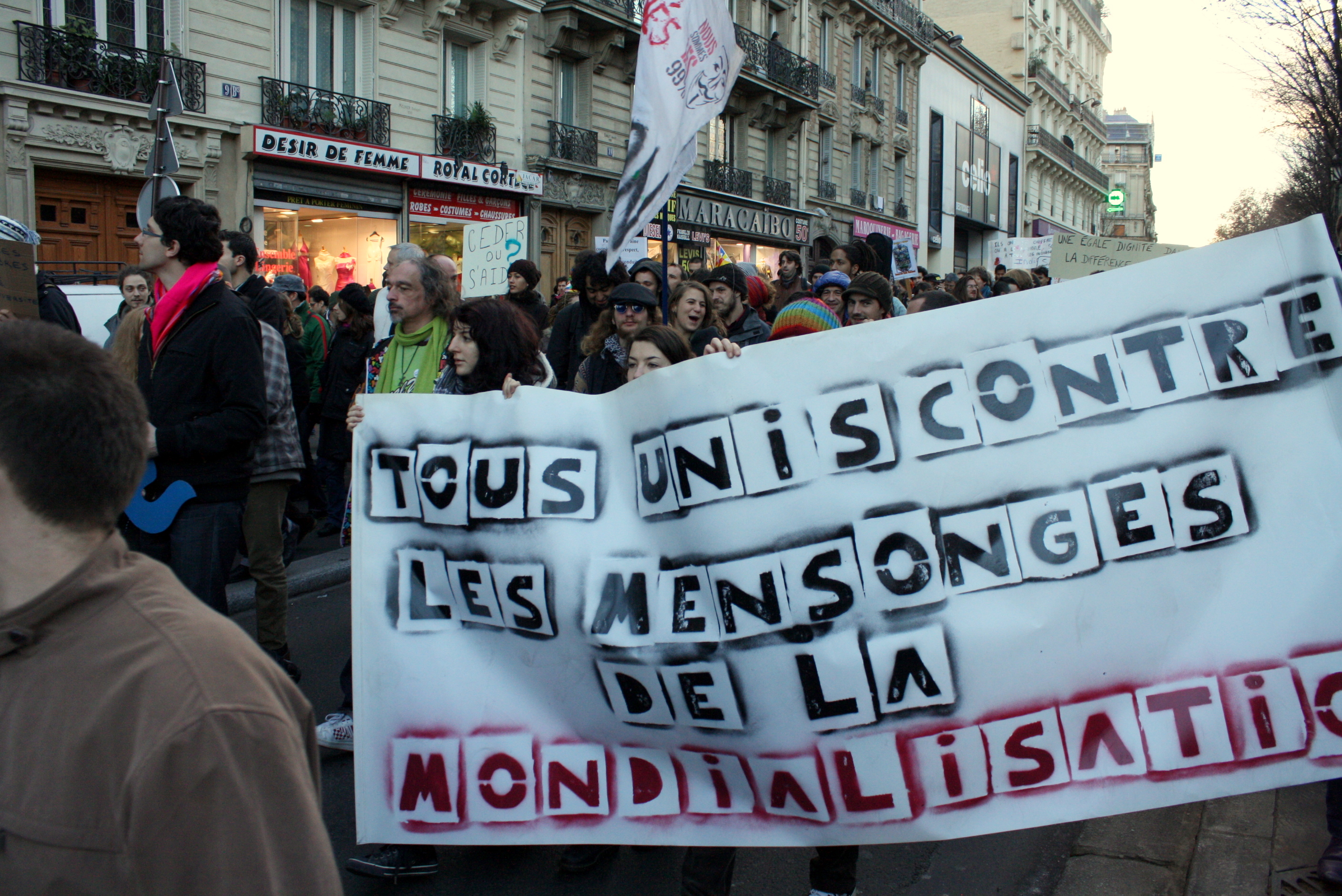

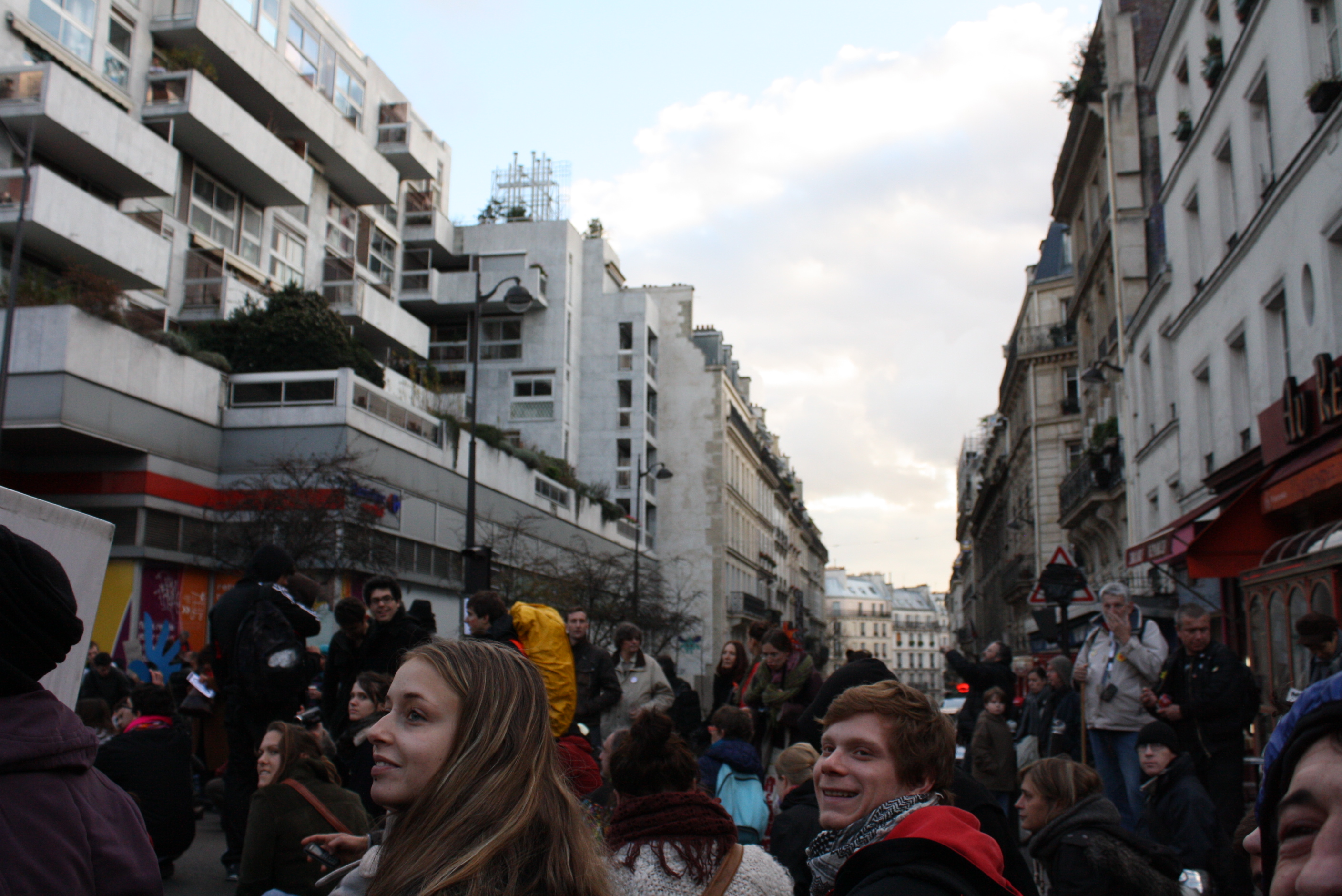

“The river is still swollen, muddy, streaked with lights. I don’t know what it is rushes up in me at the sight of this dark, swift-moving current, but a great exultation lifts me up, affirms the deep wish that is in me never to leave this land. I remember passing this way the other morning on my way to the American Express, knowing in advance that there would be no mail for me, no check, no cable, nothing, nothing. A wagon from the Galeries Lafayette was rumbling over the bridge. The rain had stopped and the sun breaking though the soapy clouds touched the glistening rubble of roofs with a cold fire. I recall now how the driver leaned out and looked up the river toward Passy way. Such a healthy, simple, approving glance, as if he were saying to himself: “Ah, spring is coming!” And God knows, when spring comes to Paris the humblest mortal alive must feel that he dwells in paradise. But it was not only this–it was the intimacy with which his eye rested upon the scene. It was his Paris. A man does not need to be rich, nor even a citizen, to feel this way about Paris. Paris is filled with poor people–the proudest and filthiest lot of beggars that ever walked the earth, it seems to me. And yet they give the illusion of being at home. It is that which distinguishes the Parisian from all other metropolitan souls.”
–Henry Miller, Tropic of Cancer, 1934


La Défense
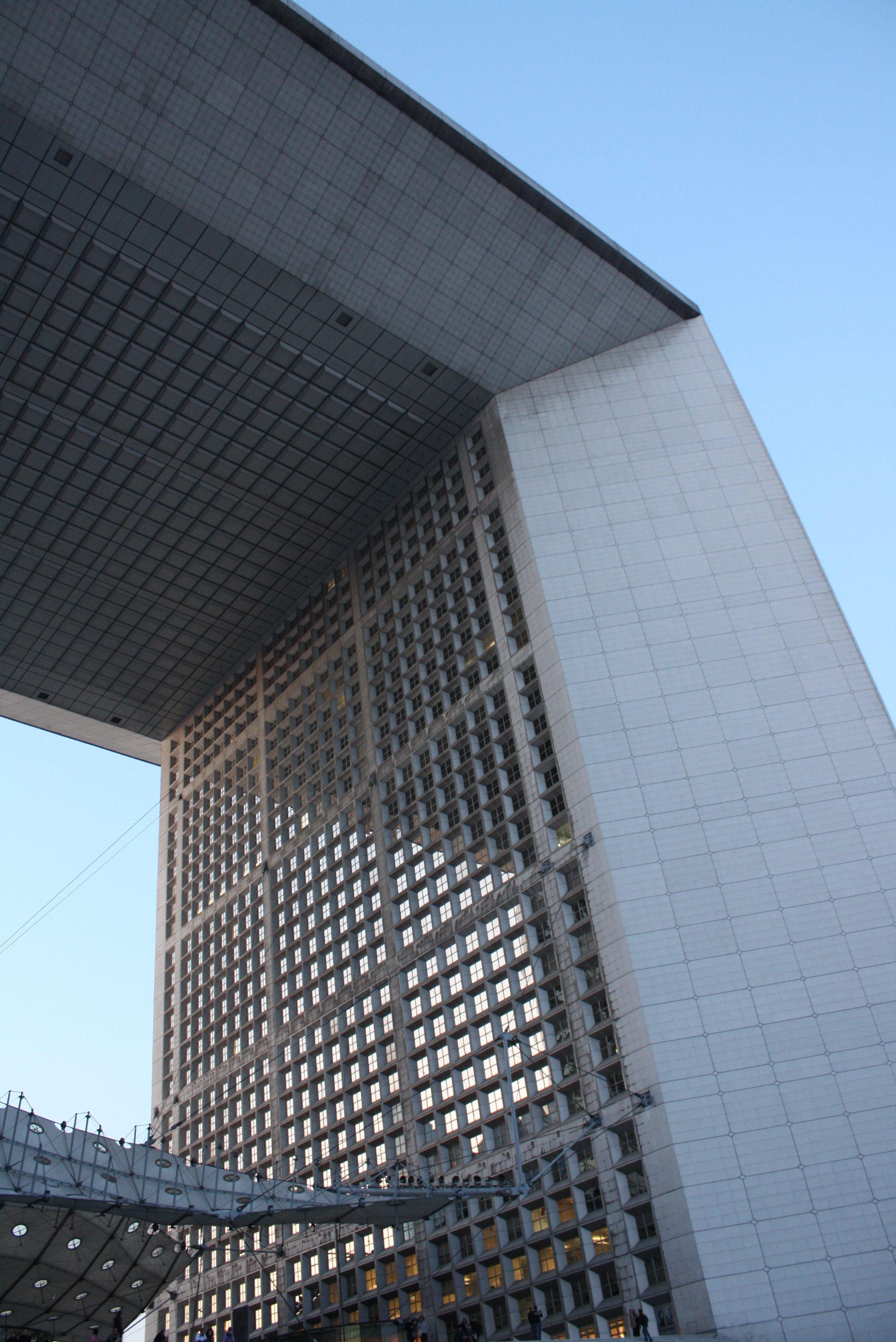
It’s not in the news, barely even in French news, but there is an Occupy encampment here in Paris. It’s just not at Hôtel de Ville. It’s at La Défense, Paris’ main financial district on the Western edge of the city that emerged in the 70s and 80s and is now the largest purpose-built business district in Europe. The district completes the Westernmost end of the Axe historique, which is a straight line leading from the Louvre through the Champs-Elysées, the Arc de Triomphe and ending at La Grande Arche, the iconic modern monument of La Défense. Originally, the axe historique allowed the King a grand vista from the Louvre (his palace) straight to the Western end of the city.
It was there that I went last weekend to attend the general assembly of Occupons La Défense. I had never been to La Défense before, always being vaguely curious about its famous architecture, so as I first stepped off the metro I was immediately struck by the enormity of La Grande Arche, and the glitz of the surrounding financial buildings. Considering Paris is one of the most well-preserved European cities, with countless buildings and cathedrals hundreds of years old and only one skyscraper, this modern outpost could be Paris’ polar opposite. According to Wikipedia, construction of La Grande Arche began in 1985 after Danish architect Johann Otto von Spreckelsen and Danish engineer Erik Reitzel won a design competition initiated by then-French president François Mitterand. Apparently, they intended the monument to serve as a 20th-century version of the Arc de Triomphe, honoring humanity and humanitarian ideals rather than military victories. Of course, the building was inaugurated with grand military parades at the bicentennial of the French Revolution. And looking at it today, the stark grey and silver angles of the structure remind me of anything but “humanitarian ideals.”
Continue reading “La Défense”
 CITIES LIKE DREAMS
