Every once in a while I look around myself and think, “Where am I? And how did I get here?”
This might be the aspect of my life for which I am most grateful.
One month ago I moved from Paris to Ramallah, in the occupied Palestinian territories. I moved for an internship at a local development organization, to experience something new, and to continue pursuing that elusive Arabic language. Of course I know the answer to “how I got here” is quite simple: there was some determination and an internship application, but it was largely my overt privilege as a university graduate and an American-passport holder. But this knowledge doesn’t stop (or perhaps it adds to) the dreamlike quality of finding myself in a new place, wondering what I am doing there and whether it will actually make any remote different to anyone (arguably, it will not). Nonetheless. I have the opportunity to share, and so I will.

Ramallah is the second largest Palestinian city in the West Bank, but it is quite small, with a population of about 300,000. You can walk most places, but I’m still figuring out how all the main neighborhoods and landmarks connect. I would love to situate myself with a map, but no good one exists of Ramallah. The few I’ve found generally don’t have street names, opting instead for a few select landmarks, though sometimes even these are in the wrong place. It’s as if even Google does not recognize the least contested of the contested space that is the occupied West Bank, as a search for Ramallah yields only a web of unmarked streets. Luckily, most people are more than obliging to give you detailed directions to your destination (if they don’t offer you a ride). But everyone uses names of supermarkets, banks, and hotels–never street names.
Ramallah is known by some, both endearingly and critically, as the “bubble” of the West bank, where it is easy to forget that you are in a land under occupation. The city is full of contradictions. Ramallah is the de facto capital of the heavily-criticized Palestinian Authority, and so is home to the government bureaucracy that helps to make life here function. Added to this is the element of continuous international presence. This is an unverified conjecture, but I’d be willing to bet Ramallah has one of the highest concentrations of NGOs of any city in the world. If you see another foreigner (and indeed you see many), chances are they are in this line of work. And while some do undertake worthwhile projects, there is no doubt many of them are sucking up donor money merely to sustain themselves as they might do in any other conflict zone of the world. Driven along the streets of Ramallah are cars with both green (Palestinian) and yellow (Israeli) license places, yellow taxis and buses, and the occasional white vehicle marked “UN” in big blue letters.
The downtown streets around the central “Manara” square (known by Anglophones as the “lions’ square” due to four lion statues gracing the roundabout) are bustling and lively and loud, depending on the day, and it’s the kind of area you can imagine has probably not changed much in decades. Shops are busy and small and close together, and the food is good, with a falafel sandwich costing 4 shekels (about 1 US dollar). Walking downhill away from the center, though, suddenly everything becomes quiet, the wider streets dotted with a few casual-but-trendy Ramallah cafés, havens for richer locals and expats alike. The ambiance can be great, but here you will pay 15 shekels just for a coffee. Further still is the newer area where my office is located, where the PA has invested a lot of money to build up shiny new buildings and roads that to me feel entirely boring and impersonal. Here is where you will find the new Caesar Hotel jutting up toward the sky, around the corner from the equally opulent Movenpick. But all this is not far from Qalandia refugee camp, which is home to 10,500 refugees originating from Ramle, Lydd, and villages west of Jerusalem that were demolished by Israel leading up to its declaration of independence in 1948.
A seemingly simple task such as my first trip to familiarize myself with my neighborhood grocery store sparked a flood of speculation and internal reflection. Though much of the West Bank is incredibly fertile, due to the occupation and accompanying restrictions on movement and economic activity, farmers are not able to reach as many markets as they’d like. So even in a Palestinian supermarket, local Palestinian products are not as ubiquitous as one might think. Instead the shelves are graced with expensive imported products from Europe, Saudi Arabia, Jordan, Turkey, and even the US (if you feel you really need a box of Betty Crocker cake mix, you can get it here). I wondered how most Palestinians even afford this stuff (answer: they probably don’t). And of course, the most common and cheapest “imported” products are Israeli. Usually there is Arabic or English in addition to the Hebrew found on labels, though sometimes there is only Hebrew. Pay for your groceries at the checkout counter with the multicolored New Israeli Shekel bills that sport the faces of prominent Zionists, and your simple trip to the grocery store is effectively imbued with layers of political meaning.
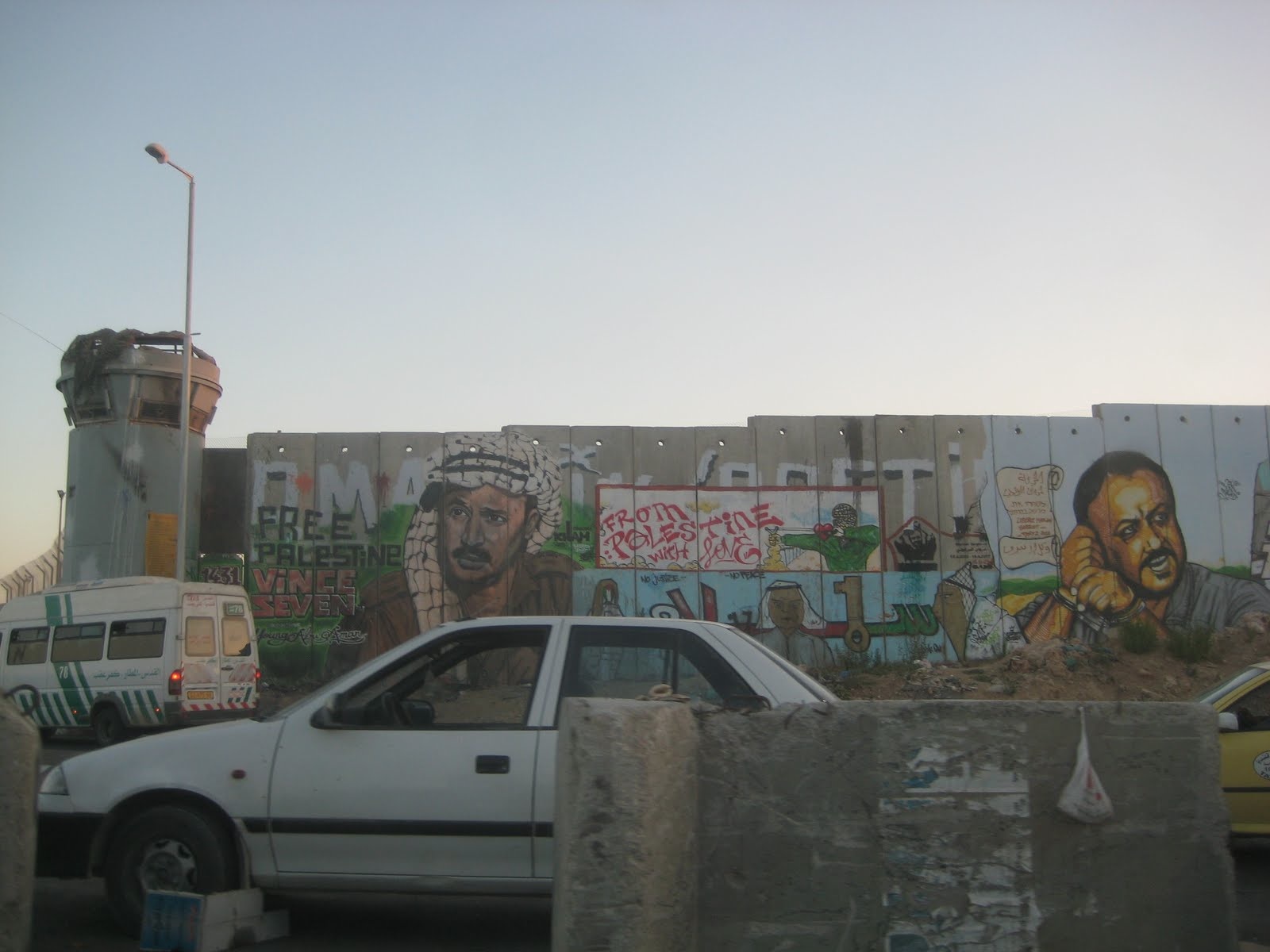
These moments of intense wonder aside, I integrated into the “bubble” quite quickly in my first week, getting used to the strange routine of full-time employment and trying to settle into my new spacious flat that is enormous compared to my previous shared Paris accommodation. I guess I was in Ramallah, but I could have been in a number of other places. It was only in my second week that I left the city, to go one evening with a friend to visit the nearby Christian village of Taybeh (for an Octoberfest, believe it or not). It was the first time I passed by the Qalandia checkpoint since I visited Ramallah briefly two and a half years ago. This is one area of Ramallah where you can see the Separation Wall, and to see it still gives me chills. The cover of night obscured much of the West Bank landscape on our drive, but there was still evidence of the absurd, divided reality in the lights dotting the darkness: the soft glowing yellow lights emanating from settlements contrasted with the harsher white lights of Palestinian towns, marked occasionally with the green light of a mosque.
It’s hard to believe how much I’ve experienced in the few weeks since then—experiences showing different extremes of reality here and often at odds with each other. On a trip to the Jordan Valley, I was able to witness the extreme poverty of Palestinian villages that are often cut off from their land and resources by the Israeli military, to the benefit of the neighboring Israeli settlements. In that area there is no such semblance of Palestinian “autonomy” like the one you find in Ramallah, where days later an unexpected dinner with an old family friend led me to a new upscale rooftop bar that looked like it could have been transplanted from the trendy Los Angeles night scene (and I felt as out of place there as I would have in a corresponding LA venue). On a different day, an obliging coworker drove me to see multiple settlements and towns of the Northern West Bank, finally allowing me to see for myself what I have for years only read about. And while much of what I’ve seen thus far has confirmed what I already knew about “the situation,” I’ve also had challenging debates with co-workers that have brought me back to thinking I know absolutely nothing.
Then, in addition to experiencing some of the famed Ramallah nightlife, I’ve also had glimpses into its art scene: first when a new Palestinian friend had me stop by a community art center where a group of young artists, architects, and engineers were working tirelessly to build a “pixelated” model cow out of tiny wooden cubes. As with most things here, there is a political message in there somewhere. And then a couple chance encounters led me to spend the evening of the otherwise-quiet Eid holiday with a prominent Palestinian hip-hop artist and an Italian rapper, where on the drive home they each freestyled over an Aaliyah song, one in his native Arabic and one in his native Italian.
Where am I? Ramallah, I guess. And it is surreal. And also wonderful.









 CITIES LIKE DREAMS
